Chord Melody Guitar Music
Guitar Tabs, Tablature
Sheet Music, Tab Books, Videos, DVD Lessons
FREE Guitar Book - "Jazz Guitar Chords & Arpeggio
Patterns"
by Stacy McKee (with your first order)
Toll Free Order Line! 1-800-913-9477
Acoustic Guitar Books/DVDs..........Classical
Guitar Books/DVDs.............Lick
Library Guitar DVDs
Beginner's Guitar Books/DVDs.......Country
Guitar Books/DVDs..............Play
Along Guitar Books/DVDs
Blues Guitar Books/DVDs................Flamenco
Guitar Books/DVDs...........Religious
Guitar Books/DVDs
Brazilian Guitar Books/DVDs..........Jazz
Guitar Course Books/DVDs.......Robert
Conti Guitar Books/DVDs
Celtic Guitar Books/DVDs................Jazz
Guitar Books/DVDs (A-K)..........Rock
Guitar Books/DVDs
Christian Guitar Books/DVDs..........Jazz
Guitar Books/DVDs (L-Z)...........Spanish
Guitar Books/DVDs
*Click Here For Featured DVDs Of The Week On Sale Now!!
Pickstyle Guitar Lesson......................................................Secure Order Form
Click to hear "April In Paris"
Guitar
Lesson by Steven Herron - press "Play"
Play Pause Stop
Dear Advancing Guitarist,
This
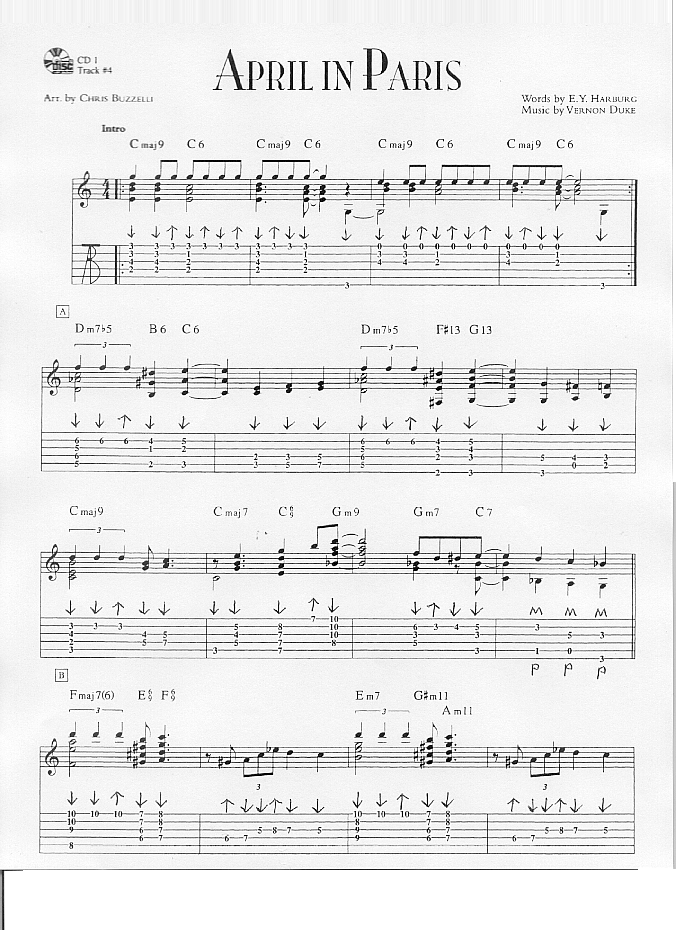
lesson presents a pickstyle chord melody guitar solo of the beautiful song "April
In Paris" arranged by jazz
guitarist Chris Buzzelli. This arrangement is from the book with 2 CDs called "Jazz
Guitar Standards: Chord Melody Solos" which is fully described below. It is an
excellent example of how a melody can be harmonized with everything from 3rds
and 10ths to 3, 4, 5, and 6 note
chord voicings!
You will also notice it is written in standard notation (for those of you who can read music) and tab notation for those of you who can't. In tab notation, the highest line of the staff towards the top of the page represents the 1st string or the highest pitched string of the guitar, while the lowest line of the staff represents the 6th string or the lowest pitched string of the guitar. The numbers on the various lines tell you what fret to press down on that particular string. So if you have the number "2" on the highest line of the staff, it is telling you to press down the 2nd fret on the 1st string of your guitar.
Also, I am
including a sound clip from one of the CDs that comes with this book so that you
can hear exactly how the song should be played. You will also notice that due to
copyright restrictions, I am only presenting the first page of the song.
Here is the book description from our website:
Jazz Guitar Standards: Chord Melody Solos
- Book and 2
CDs
Songs include: "Body and
Soul, Can't Help Lovin' Dat Man, I've Got You Under My Skin, What's New"
-arranged by Ron Berman, "All
The Things You Are, April in Paris, East of the Sun, Honeysuckle Rose, In Your
Own Sweet Way, Just
Friends" -arranged by Chris Buzzelli, "A Foggy Day, I Could Write a Book"
-arranged by Charles Chapman,
"Beautiful Love, Yesterdays" -arranged by
Corey Christiansen, "How High the
Moon, Moonlight in Vermont"
-arranged by Mike Christiansen, "As Time Goes By, Bluesette, Bye Bye Blackbird,
Invitation, It Don't Mean a
Thing, You Stepped Out of a Dream" -arranged by Dave Frackenpohl, "All of You,
But Not for Me" -arranged
by Barry Greene, "The Days of Wine and Roses, Have You Met Miss Jones, Smoke
Gets in Your Eyes, You
Go to My Head" -arranged by
Sid Jacobs, "I Love You, Watch What Happens"
-arranged by Ken Karsh,
"Alone Together, Lover Man, My Funny Valentine, Night and Day" -arranged by
LaRue Nickelson, "I Can't
Get Started, Satin Doll, Summertime" -arranged by John Purse, "The Way You Look
Tonight, What Is This
Thing Called Love" arranged by
Bruce Saunders, "Misty, Speak Low" -arranged by
Rick Stone, "Embraceable
You, Long Ago, Someone to Watch Over Me' -arranged by
Jack Wilkins.
Notation & tab / Fingerstyle & Pickstyle................................................Price
- $29.95
"April In Paris" is played in 4/4
time which means that there are 4 beats per measure and a quarter note gets 1
beat, a half note gets 2 beats, a whole note gets 4 beats, while an eighth note
gets 1/2 a beat. This arrangement
is in the key of C major which means that all of the notes are natural unless
otherwise indicated. When an arrow points down towards the floor, you
would execute a "down pick" in the same direction. When an arrow points up
towards the ceiling, you would execute an "up pick" in the same direction.
Wouldn't it be nice to actually be able to read music like a studio musician? Well here's your chance to start.
Here are some tips which will help
out your pickstyle guitar playing considerably. Hold your pick between your right hand thumb and
the left side of your index finger tip, keeping your thumb perfectly straight so that it
is tension free. The pick should be held loosely enough that there is a little give and
take when you strike a string. This way you won't feel like you're digging in or dragging
across the string. The pick should strike each string perpendicularly or straight on, as
opposed to striking the string at an angle. You will get a fuller sounding note this way.
Also, only the tip part of the pick needs to strike the string. There is no need to dig
your pick down between the strings. This creates too much resistance. When you use a pick,
your up and down picking motions come from your hand, wrist, and forearm at the exact same
time. They move as one unit in a rotary motion and your wrist stays perfectly straight. Keep
your middle, ring, and little fingers loosely held back in the palm of your hand - don't
give in to the temptation of resting your little finger on the pick guard or the face of
your guitar. This will only serve to glue you into one position and will cut down on your
mobility and freedom of motion.
Keep your left hand thumb perfectly straight - bending
your thumb is just another tension habit that should be avoided at all costs.
Your thumb will contact the back of the guitar neck slightly on its' left side, pointing towards
the ceiling and in the middle of the back of the neck. Resist the temptation to hang your
thumb over the top of the neck. Your left wrist should be slightly arched and
directly underneath the guitar neck itself. Keep your left hand fingers arched
and play on the tips of your fingers close to the
fingernails, being sure that the right side of the palm of your left hand is the same
distance from the fretboard as the left side of the palm of your left hand. This will
balance and center your left hand so that all of your fingers have an equal and fair reach
advantage. Never lift a left hand finger more than 1/2 inch away from the strings. This
alone will improve your accuracy because now you have less chance of missing the next
note, since you won't be traveling a great distance to find it. All of these
technique pointers usually take months of focused thought and practice to get
them to be habits. Be patient and read all of these pointers at the beginning of
each practice
session.
Please be sure to use the 5 step "Visualization, Mental Imagery Process" that I taught you earlier. If you have not yet received this report, here is a link that you can use to access it: www.ChordMelody.com/newpage110.htm.
I strongly urge you to work your
way through a good series of pickstyle guitar method books such as the ones by
William Leavitt, who was head of the guitar department at Berklee School of Music in Boston for decades. It is an excellent 3-volume
series of books with CDs that have lots of duets that make learning how to read
music fun! You will never be sorry if you
take the time to learn how to read music (standard notation), which is much more
descriptive, as far as subtle nuances are concerned, than tab notation is. This
skill will enable you to not just be a guitarist, but a musician as well.
Jazz Guitar Chords & Arpeggio
Patterns - Stacy McKee
-
This unique book includes 300 jazz
guitar chord
formations and matching single note arpeggio patterns in a quick reference format
that no one has ever done before!
Cross indexing makes
this manual
extremely easy to use and regardless of what style of music you play, we know
you
will find this
to be a
valuable, "must have" addition to your library. Stacy McKee was the
featured guitarist with "Les
Brown and The Band Of Renown" and for a limited
time only, we will include an exclusive copy of his book
FREE with
your first
order!
==> Click here to see the
Stacy McKee Chord Melody Solo Collection
<==
Never B#, Never Bb, Just B Natural,
Steven Herron
Peabody Conservatory trained guitarist,
performer and teacher