Need Help Choosing The Right Guitar Book or Video? Peabody Conservatory
trained guitarist Steven Herron is available to answer questions and make recommendations
that will help you become a better guitarist! Just call 1-843-838-2657 now!!
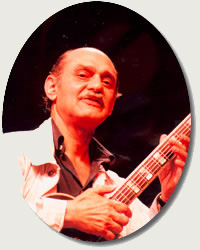
Joe Pass
Joe Pass
is one of the greatest guitarists in the history of jazz!
A genuine master of all the idioms of mainstream jazz guitar improvisation, he was
equally at home with a burning bebop line, a down home blues groove, a
sensitive "rubato" ballad, or a gentle chord melody solo.
Pass was also
highly sought after as a sideman in many diverse ensembles - including a
surprisingly successful set with Roy Clark covering Hank Williams tunes.
He also served as an accompanist to singers like Ella Fitzgerald and
instrumentalists like pianist Oscar Peterson and J.J. Johnson.
Since the early 1960s, the name Joe Pass has been
synonymous with jazz guitar and Joe's effect on his contemporaries and
subsequent generations of players is undeniable. He was a favorite
performer of Wes Montgomery during the height of Wes's popularity and
along with Howard Roberts,
Barney Kessel, and
Herb Ellis
he defined the
West Coast jazz guitar school. Pass was also an important and influential
paternal figure to emerging players like
Larry Carlton,
Jack
Wilkins, Emily Remler,
and Mark Whitfield.
A great deal of attention is devoted to his Pacific Jazz
Record Company years - often acknowledged as his "classic" years - when he
was hot, hungry and ready to show the world what he could do! For many
years these recordings - seminal masterworks and essential listening for
previous generations of guitarists - were unavailable on CD.
Consequently
they languished in obscurity and their relevance and inclusion in a Joe
Pass jazz guitar music compilation was problematic - despite the
excellence, profundity and importance of the music. Today these classic
Joe Pass albums have been rightfully given a new lease on life through
the laudable re-issue efforts of companies like Blue Note, Eupohoria, and
most of all Mosaic Records.
Joe Pass wrote several instructional jazz guitar music books
with the goal of sharing his expertise with neophytes and seasoned
guitarists alike, but often mentioned that learning as many tunes as
possible was the most valuable lesson for a player. He hoped that aspiring
guitarists, regardless of style, would find that spark of individuality
and creativity that he discovered in his youth and cultivated in his
earliest playing experiences.
Joe's improvisation approach, advanced harmonic concepts, and solo jazz
guitar chord melody style are subjects he was eager to discuss and share -
yet his mode of expression was hardly disciplined, pedantic, or scholarly.
Nonetheless Joe was a great communicator - if you listened. He spoke as in
performance through his instrument - spontaneously, casually, with humor
and great feeling - punctuating his musical discourse with a favorite
comment: "Stop me when you hear something you like". Needless to say, he
got stopped a lot!
Joe Pass - The Blue Side Of Jazz - DVD
In this superb instructional DVD, the exciting follow-up
to "Solo Jazz Guitar", jazz guitar virtuoso Joe Pass explores the blues elements of jazz guitar!
Joe analyzes and teaches jazz bebop blues, new chord patterns, blues-jazz chord substitutions, special
intros and endings, "pedal" tones, accompaniment chords, voice leadings, creating single-note
lines from chord positions, and jazz-blues improvisation combining chords and runs together! Split screen
close-ups with music and tab on screen!
(60 min) Tab Booklet Included...............................................Price - $24.95
Joe Pass - Solo Jazz Guitar - DVD
In this exciting instructional DVD, Joe teaches
information useful for both blues players and jazz "purists" with his usual wit and wisdom!
Topics covered include: chord melody, chord substitutions, leading tones, chromatic chords, voice
movements, common tones, adding color tones to your chords, learning to work within close voicings,
turnarounds, adding substitution to your melodic playing, special licks, lines vs. scales, and learning
how to create walking bass lines over chord changes. Split screen close-ups with notation and tab on screen!
(60 min) Tab Booklet Included...............................................Price - $26.95
Joe Pass Plays "Stella By Starlight"
Joe Pass - Solo Jazz Guitar - Book and Online Video
In this exciting instructional book and online video,
Joe teaches information useful for both blues players and jazz "purists" with his usual wit and
wisdom! Topics covered include: chord melody, chord substitutions, leading tones, chromatic chords, voice
movements, common tones, adding color tones to your chords, learning to work within close voicings,
turnarounds, adding substitution to your melodic playing, special licks, lines vs. scales, and learning
how to create walking bass lines over chord changes. Split screen close-ups with notation and tab on screen!
(60 min) Online Video.............................................................Price - $22.95
Joe Pass Plays "All The Things You Are"
Joe Pass - The Genius Of Joe Pass - DVD
A compilation of a series of 1962-1982
live performances that capture the essence, brilliant technique and enormous talent of Joe Pass. Also
features a brief interview with Joe. Tunes include: "The Song Is You, Soft Winds, Prelude To A Kiss,
Original Blues in G, Satin Doll, Tricotism, Sonnymoon For Two, Blues In G, Move, What Are You Doing
The Rest Of Your Life, Misty".
(75 min) Biographical booklet included................................Price - $24.95 Also Available For Instant Download - Click Here Now!
Joe
Pass Plays "Satin Doll"
Joe Pass - The Best Of Joe Pass - Book and Online Audio
A step-by-step breakdown of the styles and
techniques of jazz guitar virtuoso Joe Pass taught by
Wolf Marshall. Learn the
trademark riffs and solos of one of the greatest guitarists in the history of jazz! Each piece -
some are single note improvised solos while others are chord melody solos - also includes harmonic
analysis and performance notes! Songs include: "Blues
For Basie, Cavalerie, C.E.D, Django, A Ghost Of A Chance, For Django, Milestones, Nobody Else But You,
The Night Has A Thousand Eyes, One For My Baby, Rosetta, There Is No Greater Love".
Notation and tab...................................................................Price - $24.95
Click To Hear Audio Samples
Joe Pass Plays "Django"
Joe Pass - Play Like Joe Pass - Book and Online Audio
The Ultimate Guitar Lesson. Study the trademark songs,
licks, solos, and techniques of jazz guitar master Joe Pass! This comprehensive book and online audio teaching
method by Paul
Silbergleit provides detailed analysis of Joe's gear, tone, techniques, styles, songs, licks, improvisations, and
much, much more! You'll learn everything you need to know about Pass's legendary guitar playing - from his early
1960s recordings as a sideman to his ground-breaking solo jazz guitar albums and on to his many collaborations
with artists like Oscar Peterson and Dizzy Gillespie. Includes 5 full length songs: "Blues for Basie * Meditation *
Summertime * Tricrotism * Yours Is My Heart Alone". Also includes numerous
excerpts of even more signature Joe Pass tunes!
Notation and tab...................................................................Price - $29.95
Joe Pass Plays "Meditation"
Joe Pass - The Complete Joe Pass - Book
This book is a collage of many of Joe's thoughts
about the guitar as an accompanying and solo instrument and includes lessons on: harmony,
chord basics, chord substitutions, chord forms, neighboring chords, moving bass lines, melody, scales,
"lead-in" notes, diminished lines, chordal thinking, improvising, and blues rhythm changes. It also
contains Joe Pass jazz and blues phrases and transcribed solos including: "Bay City Blues, Foxy Chick And a
Cool Cat, Time In, Blues in G, Dante's Inferno, Grete". Joe Pass and Herb Ellis jazz duets:
"Bonnie, Jazz Waltz, Some Of These Days, G Blues, Hot Stuff, Ballad".
Standard notation..................................................................Price - $29.95
Joe Pass Plays "Bay City Blues"
Joe Pass - Essential Jazz Lines - Book and Online Audio
Taught by
Corey Christianson, contains a study of
lines used by Joe Pass, broken down and grouped according to how Joe used them
harmonically. The play-along CD exemplifies how these relate to a harmonic background. Each harmonic section
contains a play-along recording in the original key and a play-along, moving in fourths, to help the
student practice the lines in all twelve keys. Eventually, the student will learn to mix and match
these ideas and create lines of their own. The more phrases and ideas a student has, the more they are
able to improvise or juxtapose their ideas to create new melodies on their own.
Notation and tab...................................................................Price - $19.95
Click To Hear Audio Samples
Joe Pass Plays "The Way You Look Tonight"
Joe Pass - The Joe Pass Collection - Book
Songs include: "Blues For Basie, Blues For Hank,
Cheek to Cheek, Dissonance #1, Happy Holiday Blues, I Got Rhythm, In A Sentimental Mood, Pasta
Blues, Satin Doll, The Song Is You, The Way You Look Tonight, Yardbird Suite".
Notation and tab...................................................................Price - $22.95
Joe Pass Plays "In A Sentimental Mood"
Joe Pass - The Joe Pass Guitar Style - Book and CD
This book/CD is divided into 2 sections: Part 1 - Harmony, includes: chord
construction, embellishment, substitution, connection and symmetric chords. Part
2 - Melody, includes: chord scales, altered scales, ear training, whole tone
scales, chord resolutions, improvising, blues (minor, modern, 3/4), rhythm
changes, and a solo to play. Learn the sound of modern harmony and melody while
playing!
Standard notation..................................................................Price - $20.95 Click To Hear Audio
SamplesClick To See Sample
Pages
Joe Pass Plays "I Can't Get Started"
Joe Pass - On Guitar - Book and CD
Joe explains his approach to the process
of jazz improvisation. Also an overview of "The Three Harmonic Families"- lines, scales, and chord
superimpositions and substitutions that Joe uses. Includes 50 musical examples and 3
note for note transcriptions of: "Stella By Starlight, Joe’s Blues,
and All The Things You Are".
Notation and tab...................................................................Price - $24.95 Click To Hear Audio
SamplesClick To See
Sample Pages
Joe Pass Plays "Joe's Blues"
Joe Pass - Virtuoso Standards Songbook Collection - Book
Solo guitar arrangements include: "Have You Met Miss Jones,
I Can't Get Started, In Your Own Sweet Way, The Man I Love, On Green Dolphin Street, Round Midnight, Sweet Lorraine".
Notation and tab...................................................................Price - $21.95 Click To See Sample
Pages
Joe Pass Plays "On Green Dolphin Street"
Joe Pass - Jazz Play Along - Book and CD
For use with all B-flat,
E-flat, Bass Clef, and C instruments, the Jazz
Play-Along series is the ultimate learning tool for all jazz musicians. With
musician-friendly lead sheets, melody cues, and other split-track choices on the
included CD, this first-of-its-kind package helps you master improvisation while
playing some of the greatest tunes of all time. FOR STUDY, each tune includes a
split track with: * Melody cue with proper style and inflection * Professional
rhythm tracks * Choruses for soloing * Removable bass part * Removable piano
part. FOR PERFORMANCE, each tune also has: * An additional full stereo
accompaniment track (no melody) * Additional choruses for soloing. INCLUDES:
"Catch Me * C.E.D. * Chlo-e * Fleur d'Ennui * For Django * A Foxy Chick and a
Cool Cat * Hang Tough * Just Friends * Lullaby of The Leaves * Soon".
Standard Notation................................................................Price - $16.95
Click To Hear Audio Samples
Joe Pass Plays "Just Friends"
Joe Pass - Omnibook - Book
Note-for-note full length solos
of over 30 Joe Pass classics from numerous recordings spanning his entire career!
Songs include: "All The Things You Are, But Not For Me, Catch Me, Cavalerie,
C.E.D., Chlo-e, Django, 500 Miles High, For Django, Giant Steps, Have You Met
Miss Jones, I Love You, In A Mellow Tone, Just Friends, Limehouse Blues, Love For
Sale, Our Love Is Here To Stay, Meditation, Night And Day, The Night Has A Thousand
Eyes, Oleo, Robbin's Nest, Rosetta, Satin Doll, Soon, Speak Low, Stella By Starlight,
Stompin' At The Savoy, Tricrotism, Watch What Happens, Windows, Yardbird Suite,
You Stepped Out Of A Dream." Approximately 300 pages long!
Notation and tab...................................................................Price - $39.95
Joe Pass Plays "But Not For Me"
Jazz Guitar Lines Of The Greats - Book
Includes 675 transcribed
licks and phrases from five of the greatest jazz guitarists of all time:
Tal Farlow,
Pat Martino,
Wes Montgomery,
Joe Pass, and Jimmy Raney!
The phrases are separated into five sections; major lines, minor lines, major ii/V7/I lines, minor ii/V7/I
lines, and dominant 7 lines. These "textbook" jazz phrases are perfect for all
instruments---not just guitar. Spiral bound for easy opening and page-turning.
Over 100 pages of incredible jazz guitar licks!
Standard notation.................................................................Price - $19.95
Joe Pass Plays "Rosetta"
Jazz Guitar Masters Play Gershwin - Book
Ten incredible note-for-note
transcriptions of solo jazz guitar arrangements from the original recordings as
played by the pre-eminent jazz guitarists of our time including Kenny Burrell,
Joe Pass, Johnny Smith and others! Never before available arrangements include:
"But Not for Me (Kenny
Burrell) * Embraceable You (Earl Klugh)
* A Foggy Day
(George Van Eps)
* I Got Rhythm (Martin Taylor)
* I Love You Porgy (Johnny Smith)
* Isn't
It a Pity (Howard Alden)
* My Man's Gone Now (Ralph Towner) * Someone to Watch
Over Me (Jimmy Raney)
* Summertime (Joe Pass) * They Can't Take That Away from Me (Ted Greene)".
Notation and tab...................................................................Price - $16.95
Joe Pass Plays "Summertime"
The Best Of Jazz Guitar - Book and Online Audio
Guitarist Wolf Marshall
presents a step-by-step breakdown of the guitar styles and techniques of some of the greatest jazz guitarists
of all time! Several versions are presented of each song allowing you to see how different guitarists would
arrange the same piece of music! Each piece - some are single note improvised solos while others are chord
melody solos - also includes harmonic analysis and performance notes! Songs include: "St. Thomas" -
Jim Hall, Tal Farlow,
Kenny Burrell, "All Blues" -George Benson, Kenny Burrell,
Pat
Martino, "So What" -Barney Kessel, George Benson, "All The Things You Are" -Hank Garland,
Pat Metheny,
"Honeysuckle Rose" -Joe Pass and
Herb Ellis,
Charlie Christian, "Satin Doll" -Howard Roberts, Joe Pass,
"Yesterdays" -Johnny Smith,
Tal Farlow, Wes Montgomery, "Misty" -Barney Kessel,
Wes Montgomery,
Howard Roberts, "I'll Remember April" -Johnny
Smith,
Grant Green, "How Insensitive" -Pat Martino,
Emily Remler. Each selection also includes authentic matching audio with backing tracks!
Notation and tab...................................................................Price - $29.95
Click To Hear Audio Samples
25 Great Jazz Guitar Solos - Book and Online Audio
From Charlie Christian and Django Reinhardt to Wes Montgomery, Pat
Metheny, Kenny Burrell, Jim Hall, Joe Pass and beyond, take an inside look at the genesis of jazz guitar! This book
and online audio by Paul Silbergleit provides
solo transcriptions in standard notation and tablature, lessons on how to play them, guitarist biographies, equipment,
photos, history, and much, much more! The accompanying audio contains full-band demonstrations of every guitar solo
in the book! Songs include: "The Acrobat" -Peter Bernstein, "Benny's Back"
-George
Benson, "The Days Of Wine And Roses" -Pat Martino,
"East Of The Sun" -Johnny Smith,
"East To Wes" -Emily Remler,
"Embraceable You" -Oscar Moore, "Full House" -Wes
Montgomery, "I Thought About You" -Bobby Broom, "I've Found A New Baby" -Charlie
Christian, "If I Should Lose You" -Kurt
Rosenwinkel, "Jean De Fleur" -Grant
Green, "Like Someone In Love" -Tal
Farlow, "Lover Man Oh Where Can You Be" -Joe Pass, "Lullaby Of Birdland" -Barney
Kessel, "Lyresto" -Kenny
Burrell, "Nardis" -Mike
Stern, "No Blues" -John
McLaughlin, "Nothing Personal" -Pat
Metheny, "Orange Brown And Green" -Herb
Ellis, "Relaxin" -Hank Garland, "Spring Is Here" -Jimmy
Raney, "Swing Spring" -John
Scofield, "Whisper Not" -Jim Hall,
"The World Is Waiting For The Sunrise" -Django Reinhardt,
"You Don't Know What Love Is" -John Abercrombie.
Notation and tab...................................................................Price - $24.95
Click To Hear Audio Samples
Joe Pass - A True Jazz Guitar Genius!
Compiled & Edited By
Steven Herron
If Joe Pass had not been sidelined with illegal drug dependency, he
definitely would have taken part in the exciting jazz guitar surge of the
fifties. As it was, fate had other ideas for Joe Pass. After knocking about in
and out of jail for over ten years with heroin addiction, Joe got admitted to Synanon which was basically a drug rehab facility in 1960.
Joe Pass first acquired public recognition with his guitar playing
as part of the house band on 1961's "Sounds Of Synanon". His debut record album
"Catch Me", and its' historic follow up "For Django", developed Joe Pass's
credentials in no uncertain terms. By 1965, he was in demand as one of the most
requested jazz sidemen of the time, backing up musicians such as George
Shearing, Groove Holmes, Gerald Wilson, Benny Goodman, and Les McCann.
At
decade's end, Joe Pass had actually released a bunch of records on the Pacific
Jazz label (these are finally offered on CD in a must have Mosaic Records'
collection) and was a regional legend in the Los Angeles jazz guitar scene. Lee Ritenour once referred to him as "The President Of Bebop" on the West Coast, a
thought shared by many up and coming jazz guitar players of the day.
In 1972, Joe Pass broke new ground with his "Virtuoso" record
album. The promise made by his Pacific Jazz recordings was fulfilled on
"Virtuoso". This record featured Joe Pass playing unaccompanied, improvised jazz
guitar for an entire program of twelve tracks! A collection that seems as fresh
and outstanding today, "Virtuoso" elevated the bar in the jazz music industry
overnight.
From this point on, the word "virtuoso" came to be Joe's handle. He
was the undisputed king in the solo jazz guitar category and held this position
until his untimely demise in 1994. In retrospect, Joe Pass is among the most
vital jazz artists of the twentieth century and continues to be the essential
"complete" jazz guitar player.
Stories from the Joe Pass mythos have it that Gene Autry, "The
Singing Cowboy", motivated a 9 year old Joseph Anthony Passalaqua to take up the
guitar and become one of the world's best artists - an idealized and enchanting
image but barely precise. Joe Pass debunked that story years back.
Reality be
revealed, Joe himself didn't remember specifically what propelled him to begin
playing guitar - he just did. When he did, he participated in the neighborhood
popular music scenario in Johnstown, New Jersey - merely hanging out with
various other guitarists, learning Italian sing-along songs of the day, and
listening. Huge amounts of listening!
For almost a year and a half, Joe Pass took official guitar lessons
with a regional multi-instrumental musician. He discovered how to read formal
music, worked through some Nick Lucas guitar method publications, and examined
some basic finger style guitar techniques from the
Carcassi Classical Guitar
Method.
At this age, he practiced around six hours a day under the
careful eye and rigorous analysis of his dad. By age twelve, Joe Pass was an
excellent improviser and was playing professionally at local dances with older
artists. In this time period, he came to be aware of jazz players like
saxophonist Ben Webster and trumpeter Roy Eldridge.
In the forties, jazz guitarist Joe Pass was drawn to the modern
jazz guitar sounds originating from New York City. There he came to be
conversant in the new musical language of bebop and jammed with numerous of its
leading entertainers. Joe mentioned Dizzy Gillespie, Charlie Parker, Art Tatum,
and Coleman Hawkins as influential in this phase of his development. In later
years, he was also influenced by the piano playing of Oscar Peterson. Joe Pass
has cited only 3 guitarists as having an influence on his guitar style:
Charlie
Christian, Django Reinhardt, and
Wes Montgomery.
Joe Pass has actually been likened, and justly so, to the wonderful
wind (sax and trumpet) and keyboard performers of jazz. In a pure music sense,
his single note improvisation style has a lot in common with instrumentalists of
the classic bebop and hard bop schools. Hardly one for labels, Joe Pass has
constantly referred to himself as an improvisation musician that just so happens
to play and express himself via the guitar.
Nonetheless, his agile single note
lines have many of the melodies and phrases one associates with jazz giants like
Charlie Parker, John Coltrane, Dizzy Gillespie, Clifford Brown, and Sonny
Rollins. It is mostly from this framework that he played. His implementation and
methodology were hornlike and on par with his wide range of ideas and enormous
vocabulary, permitting single note improvisations to flow like a saxophonist's
stream of consciousness.
Joe Pass likewise had a tougher, funkier element to his playing
that merged bluesy string bends, double stops and partial chords, mutated swing
licks, and rhythmically charged R & B influenced riffs. This side of his musical
personality emerged early on in solos with hard bop players like Groove Holmes
and Les McCann along with on blues and rock flavored numbers like "Ode to Billie
Joe" on the 1970's "Intercontinental" album.
Over the years, Joe Pass established an extremely unique harmonic
methodology that equals most pianists' playing. He was especially skilled at
thinking up unaccompanied chord melody solos. These mini-masterpieces are
brilliantly showcased on the "Virtuoso" record albums and a lot of other solo
albums. In this setting, Joe was really in a league of his own.
Utilizing a wide array of finger-picked, hybrid-picked, and
flat-picked articulations along with a trademarked mix of ad lib chord passages,
spontaneous counterpoint, and fleet bebop lines, he has actually reinterpreted -
that is, basically re-written at will - numerous of the greatest standard tunes
of history.
Many guitarists have been surprised to learn that Joe Pass played Fender solid
body guitars on his early jazz guitar recordings. Normally
associated with surf and rock and roll performers, the Fender Jazz Master and
Fender Jaguar models seem unlikely foils for his advanced bebop style, but Pass
made the most of his circumstances.
His Fender guitar sound is heard on
recordings like 1961's "Sounds of Synanon", 1962's "Something Special (Groove
Holmes) and "Moment of Truth" (Gerald Wilson), and 1963's "Catch Me", his first
album as a leader. He also employed a Fender Bass VI six string bass guitar for
a couple of tracks on the latter date. Pass used a thin line Gibson ES-355
briefly during 1963. This was heard on his sessions as a sideman with Les
McCann.
Pass played these atypical jazz guitars until a kind and generous soul, Mike
Peak, gave him a Gibson ES-175D in 1963. This guitar is an archtop electric
acoustic with two humbucking pickups, a sunburst finish and a 16 inch laminated
body. The 175 produced the definitive Joe Pass sound and became his workhorse
instrument for most of his career. It is heard prominently on such classic
recordings as 1964's "For Django" and "Joy Spring", 1967's "Simplicity" and
1963's "Jazz Concord" (with Herb Ellis).
In the 1970s and 1980s, Joe Pass dabbled with a few other jazz archtop guitars,
including a custom made James D-Aquisto archtop acoustic with a thinner body and
a floating pick up, and an Ibanez JP-20 signature model. He later lent his name
to a line of Epiphone Joe Pass Signature guitars in the 1990s. In 1992 Joe took
delivery of a custom made Gibson ES-175.
According to jazz guitarist John Pisano,
Pass's longtime friend and frequent musical collaborator, this instrument has a
thinner body, a single humbucking pickup, a sunburst finish, gold-plated
hardware, and an ebony fingerboard. Pisano also mentioned that this is the
guitar heard on Joe's final recordings, including his last: "A Meeting of the
Masters: Roy Clark & Joe Pass Play Hank Williams".
Like most jazz guitarists, Pass used the neck pickup on his ES-175 almost
exclusively and adjusted the tone control to produce a warm bassy sound. Joe was
supplied with a full custom medium to heavy gauged set of strings from GHS. Joe
had an unusual habit of breaking or biting his picks in half to a smaller size
that he felt was more comfortable. These were originally smaller teardrop shaped
picks and after breaking them he played with the pointed end.
In the 1960s, Joe usually performed and recorded with various Fender tube
amplifiers. He used several combo and piggyback models including a Twin Reverb
and a white Tolex Bandmaster. The latter was seen and heard mated to a Fender
Jaguar in a telling 1962 TV performance included on the "Genius of Joe Pass"
DVD. Session photos reveal that an Ampeg combo amp was used during the landmark
"For Django" recording.
By the early 1970s, Pass switched to Polytone
solid-state amps and became one of the company's leading endorsers. Fortunately
for aspiring guitarists, Joe Pass released numerous jazz guitar tab books and
instructional DVD courses that teach his single note improvised solos and chord
melody solos as well as the pickstyle and fingerstyle guitar techniques he used
to play them.
Jazz Guitar Chords & Arpeggio
Patterns - Stacy McKee - This unique book includes 300 jazz
guitar chord formations and matching
single note arpeggio patterns in a quick reference format that no one has ever
done before! Cross indexing makes this manual extremely easy to use and
regardless of what style of music you play, we know you will find this to be a
valuable, "must have" addition to your library. Stacy McKee was the
featured guitarist with "Les Brown and The Band Of Renown" and for a limited
time only, we will include an exclusive copy of his book
FREE
with your first order!
==> Click here to see the
Stacy McKee Chord Melody Solo Collection
<==
Please get in touch with us personally if you have any questions.
Just call 1-843-838-2657 for help or to place your order.
You can easily place your
order by calling 1-843-838-2657 now!
OR click on this link to use our
Secure Order Form
All orders are backed by
our "exclusive" 30-Day No-Risk Guarantee!